
How Many Cigarettes in a Pack? Truth
Pack Sizes in 2026
Know the number or the cigarettes in a pack in 2026! Our guide is about the global standards, country regulations in Australia and the US and the reason why 20 is a norm. Find out what is really going on with the cigarette packaging and carton sizes today!

Emily Parker
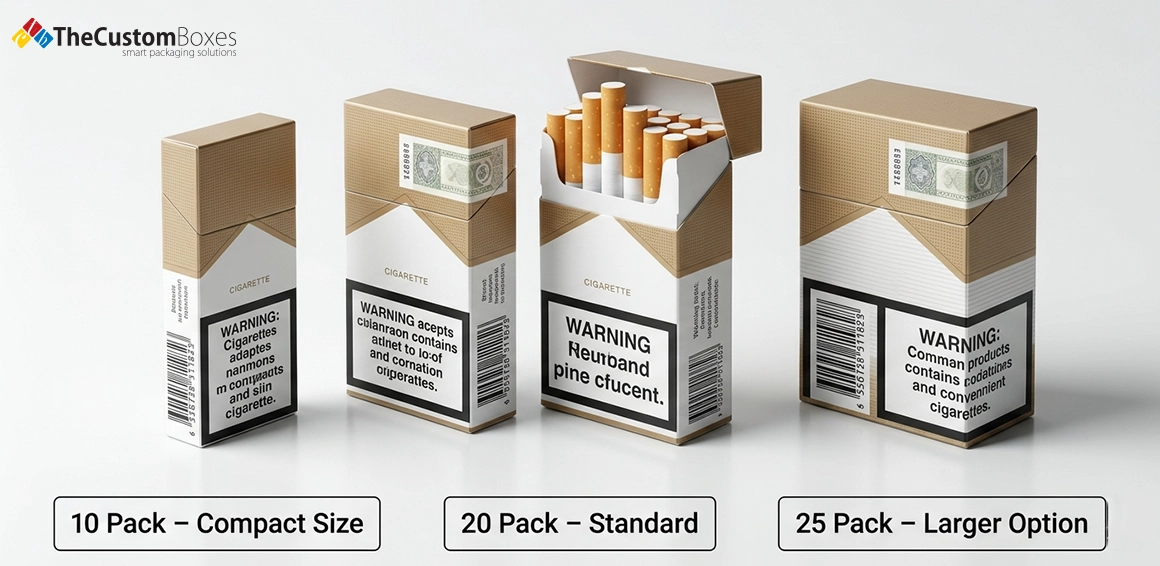
You will still see the rows of cigarette packs that are identical when you walk into a convenience store in 2026. Yet the reality is that pack sizes are by no means universal. Cigarette packs in Australia usually have 20, 40 or more sticks inside, that is the standard one most people know. But companies do other sizes too, like custom ones that fit different budgets or how often someone buys them.
Governments get involved with rules on these packs to keep prices in check and cut down on smoking overall for health reasons. It seems important for smokers to get this, but also for retailers and wholesalers, even policymakers need to understand the differences.
In this blog, we explore the history of how pack sizes started and change from place to place around the world.
How Many Cigarettes are in a Standard Pack?
Most people know that 20 cigarettes are in a pack in Australia. This number became the global norm a very long time ago because it was easy. It is the perfect amount for a smoker to use in one single day. This helps the tobacco companies plan how much they need to make every single month. It also makes it very easy for the government to decide on the right taxes.
There is a big reason why 20 became the standard for every cigarette box design you see. In the early 1900s, companies found that 20 sticks fit perfectly into a small cardboard box. This cigarette box was small enough to fit into a pocket but big enough to hold a lot. Before this, people often bought tobacco in bulk or in very large and heavy tins. The change to 20 sticks made smoking much more portable and convenient for the average person.
The history of the box of cigarettes is actually quite long and full of many changes. In the 1880s, American companies were the very first to use these cardboard boxes with 20 sticks. This was way before there were any strict rules about how to sell tobacco to people. Laws now say exactly how many in a pack of cigarettes must be sold to the public. Many countries have passed "minimum pack laws" to make sure that small packs are not sold.
Cigarette Pack Sizes by Country in 2026
-
Australia
In Australia, the rules for cigarette boxes are much different than in other places. You can find many different sizes like 20s, 25s, 30s, 40s, and even huge packs of 50. This is because the market there likes to give smokers more choices for their money. However, even with more sticks, the prices are still very high because of the taxes. Most people there choose the 25-pack because it is the most popular choice in shops.
Australia is also famous for having very strict "plain packaging" laws for every single brand. This means that every cigarette box must look exactly the same and have no bright colors. They use a dark, ugly green color that is meant to make smoking look very boring.
The only things allowed on the box are health warnings and the name of the brand. This was done to stop people from thinking that smoking is cool or exciting in any way. The impact of high taxation is a very big deal for anyone buying tobacco in Australia.
-
United States
You will rarely find any other size when you walk into a gas station or store. The machines that make the boxes are all set up for the 20 number of sticks. It keeps everything simple for the stores and for the people who buy them.
The FDA regulations have made it harder for companies to sell these tiny "kiddy packs" anymore. This keeps the market very consistent across all fifty states in the country.
-
United Kingdom
The United Kingdom has a very restrictive prohibition on any packs containing fewer than 20 cigarettes. This is to say that you have not been able to purchase a 10-pack as you used to many years ago.
These are regulations of the TPD, which is abbreviated to Tobacco Products Directive. The cigarette box packaging should also be of a particular size that enables it to accommodate all the warning labels. This ensures that no one is unaware of the dangers of using the product before purchasing it.
-
Canada
The 20- and 25-cigarette packs are incredibly widespread in Canadian stores. The 25-pack is, in fact, quite a popular one since it is a little longer for the user. The Canadian laws are quite comparable to the Australian and the United Kingdom laws in terms of health.
They also package plainly to ensure that the boxes are not appealing to the kids. This is in the grand scheme of ensuring that Canada is smoke-free in the coming years.


Why Cigarette Packs Contain 20 Cigarettes

One big reason for the 20-count is that it helps with manufacturing standardization across the world. Our company, TheCustomBoxes, understands that having one size makes production much faster and cheaper.
When every box is the same, the machines do not have to be changed very often. This allows companies to make millions of packs every day without any big mistakes or problems. It is all about being efficient and keeping the costs low for the business owners. This helps the government collect money that can be used for schools and hospitals later on.
It also stops companies from trying to trick the system with odd-sized boxes for their products. Retail pricing psychology plays a very big role in why we see 20 cigarettes per pack. For a long time, the price of a 20-pack was seen as the "sweet spot" for smokers.
Are 10-Cigarette Packs Still Sold in 2026?
Even 10-cigarette packets are already forbidden and illegal to sell in most states across the world. Governments have determined that these small packs were making it too easy to induce people to smoke. Taking them away, they would like to inspire people to give up or never begin at all. This forms a large portion of the world's war against the tobacco industry today.
The largest factor that led to this ban is the prevention of smoking by youth and the protection of children against any harm. Small packs are cheaper, and this implies that a teenager who has a tiny allowance would purchase them.
The minimum size is increased to 20, which increases the price and makes it unaffordable to many children. It is just a mere means of employing money to save the health of children. A majority of the health professionals believe that this is among the most effective means of preventing new smokers.
Different Types of Cigarette Packs
There are many different types of cigarette boxes that you can see on the shelves today.
- Hard pack: These are made of strong and sturdy cardboard. This box protects the cigarettes from getting bent or broken while they are in your pocket. It also has a flip-top lid that is very easy to open and close. This design has been the favorite of most smokers for over a hundred years now.
- Soft packs: They are another type of cigarette box packaging that some people still like to use. Rather than using thick, hard cardboard, these are composed of foil and thin paper. Although they are not as popular as they once were, several vintage brands continue to employ soft packets.
- Slide packs: They are a very cool and unique way to package cigarettes for a modern brand. Instead of a lid that flips up, the inner part of the box slides out from the side.
- Slim packs: They are designed for cigarettes that are much thinner than the regular ones you see. Because the sticks are small, the cigarette box dimensions are also much narrower and sleeker.
- Plain packaging: The latest appearance of a box of cigarettes in numerous countries is plain packaging. This, as we have mentioned, implies that the box lacks logos and is painted in a very drab colour. It is supposed to be the opposite of what is deemed attractive, so that people will never feel like buying it.
A carton, or bigger unit, contains many distinct packs of cigarettes. A carton contains 10 packs of cigarettes, commonly adding up to 200 total cigarettes. To our various customers, The Custom Boxes produces small packages and enormous boxes.
How Many Cigarettes in a Carton?
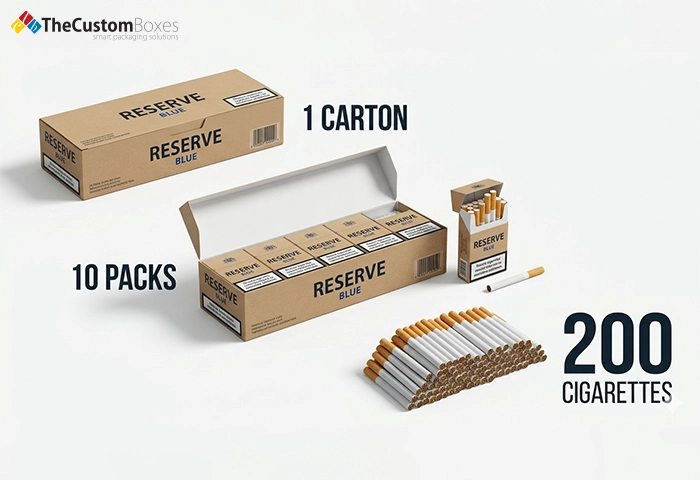
A typical customer has nearly 10 packs in a carton. 20 cigarettes make up a pack, hence 200 cigarettes in a carton. It is a commonly available standard size in nearly all the duty-free shops at the airport.
It is a very convenient way for travellers to bring home their favourite brands from other countries. Most stores will keep these behind the counter because they are very valuable items. The 200-cigarette standard is recognised by most customs and border officials around the world.
When you travel, there is usually a limit on how many cigarettes are in a carton you can bring. Most of the time, you are allowed to bring one full carton without having to pay extra taxes. If you bring more than that, you might have to pay a big fine to the government. This helps to stop people from selling tobacco illegally across different country borders.
Pricing Factors in 2026
The largest portion that makes a box of cigarettes cost as much as it does today is the tobacco excise tax. The government injects a significant amount of money into the price to cover the cost of health care. These taxes will increase in nearly all countries in 2026 in an attempt to prevent smoking.
This renders a pack very expensive, even more than 20-30 dollars in some locations. This is done to ensure that it becomes so costly that individuals determine that it is not worth the money. This is accompanied by inflation, which makes everything expensive, including your favourite pack of cigarettes.
Regulatory bodies such as the Australian Taxation Office (ATO) are keeping extremely busy in 2026. They are able to safeguard the legal businesses and the people by monitoring the market closely. A major factor that has made the tobacco market so tightly regulated in the modern world is the hard work.
Conclusion
We have understood a great deal regarding the number of cigarettes per pack and the importance of this. The 20-stick standard with 20 sticks is an international standard that assists in taxes and health. We have also witnessed that various other nations, such as Australia and the UK, have their own special rules for boxes. Packaging is a container, but it is also a means through which the government can speak to people. It is either a hard pack or a soft pack, but the aim is always the same.
The Custom Boxes is proud of assisting brands to make the best packaging available to them. We understand that appropriate design can be a significant change in any form of business. You can purchase the boxes from our company to improve your brand or business today, in case you want to make your brand look professional and attractive. We are never too far to assist you in getting the right size and style of your products.
Thanks for your visit to our blog on the truth of the pack sizes of cigarettes in 2026. You should never forget to look at the laws in your country of origin when purchasing or selling any tobacco item. The Custom Boxes is the company that you should choose as a partner in everything connected to the packaging and design!
Frequently Asked Questions
-
How many cigarettes are in a normal pack?
An average or normal pack consists of 20 cigarettes.
-
Why are there 20 cigarettes in a pack?
The 20 was adopted because of a number of historical and regulatory factors:
- Taxation: Governments found it convenient to use 20 as a unit of calculating excise taxes.
- Convenience: It is small enough to fit in a pocket, but will last an average smoker all day.
- Health Control: In most countries, a minimum of 20 is required to raise the initial cost and this will deter young individuals and casual smokers from purchasing them.
-
Are 10-cigarette packs legal in 2026?
In most Western markets, no. The policies mandate that at least 20 cigarettes per pack should be a minimum to discourage cigarette smoking among the young.
-
What is a 10 pack of cigarettes called?
A pack of 10 cigarettes has frequently been known as a half-pack, or a kiddy pack
-
How many cigarettes are in a carton?
A normal carton has 200 cigarettes. This is normally packed in 10 separate packs of 20 cigarettes.
-
Which country has the largest cigarette pack sizes?
The highest legal pack size is associated with Australia and Canada.
-
How many cigarettes does the average smoker use per day?
- Normal: 10-12 cigarettes on a daily basis.
- Heavy Smokers: 20 or above (one pack).
- Social/Light Smokes: 1- 5/day.
-
Did cigarette pack sizes change in 2026?
Although the 20-stick standard remains the same, Plain Packaging and Graphic Warnings have continued to be pushed in 2026.
-
How many puffs are in one cigarette?
The average number of puffs of a cigarette is 8 to 12. This will vary according to the brand, the length of the cigarette (e.g. King Size vs. 100s) and the depth in which the smoker inhales.
Premier American Manufacturer of Packaging and Custom Boxes
Experience the ease of creating and ordering custom boxes and affordable packaging online with the Custom Boxes. Contact us today to discover how we can turn your packaging vision into a reality.

Payment & Security
 No Hidden Charges
 Money Back Guarantee
thecustomboxes.com.au online guarantee the privacy of all the customers and never share their personal information with third parties. For more details read our Privacy Policy.


you might also like